
Postcard History
Postcards provide a fascinating and illuminating area for family history research. The first two decades of the 20th century were a golden period for postcards. They were cheap to send, and like texts of today, were simple to prepare and send. No labouring over the words of a formal letter – suffice to say Hello with a few words of small talk, and send your recipient a pretty scene, or a personalised real photo postcard. Unlike text messages of today, that are likely to be lost and forgotten in a few years, large numbers of these postcards live on – even a hundred or more years later. And they may give you the opportunity to see the handwriting, and writing style, of an ancestor, see the street where they lived (as it was then), or see the transport they used. Whilst many of these postcards are unposted (i.e. without much historical written information and addresses) they still provide us with a fascinating insight to the everyday lives of our ancestors and the society they lived in. Let’s take a brief look at postcard history and the British postal system. FamilyHistory.co.uk holds a large quantity of historical artefacts, including vintage postcards, and as we look at postcard history we can share some unique historical items with our visitors.
British postal system improvements
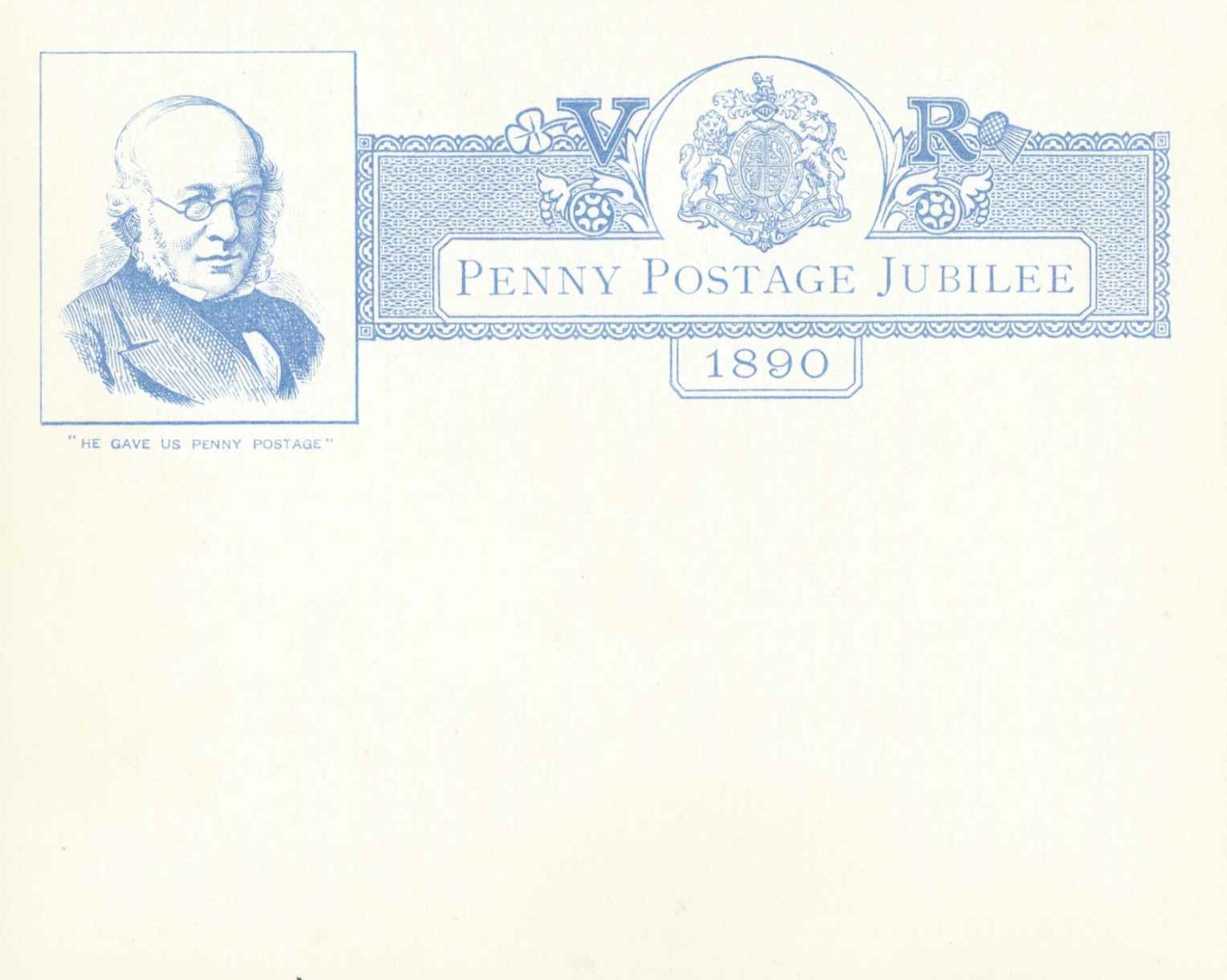
Card issued in 1890 to celebrate 50 years of Penny Postage overseen by Sir Rowland Hill (pictured top left).
The popularity of postcards in the early 1900s was very much due to the efficiency, and the relatively low cost, of using the British postal system. Sir Rowland Hill (1795-1879), a teacher, reformer, government official and postal administrator was responsible for much of this change. He campaigned to lower the cost of postal services on the basis that lower cost would lead to greater demand. He also argued for a uniform rate across the whole country. He was right, and following a short period of fourpence post, the penny post rate was introduced on 10th January 1840. Demand soared and efficiencies kicked in. In addition he oversaw the introduction of the world’s first adhesive stamp in May 1840. The iconic Penny Black was a tremendous success and countries around the world followed Britain’s lead.

Matching envelope for the above card issued on behalf of South Kensington Museum to celebrate the Post Office Jubilee of Uniform Penny Postage.
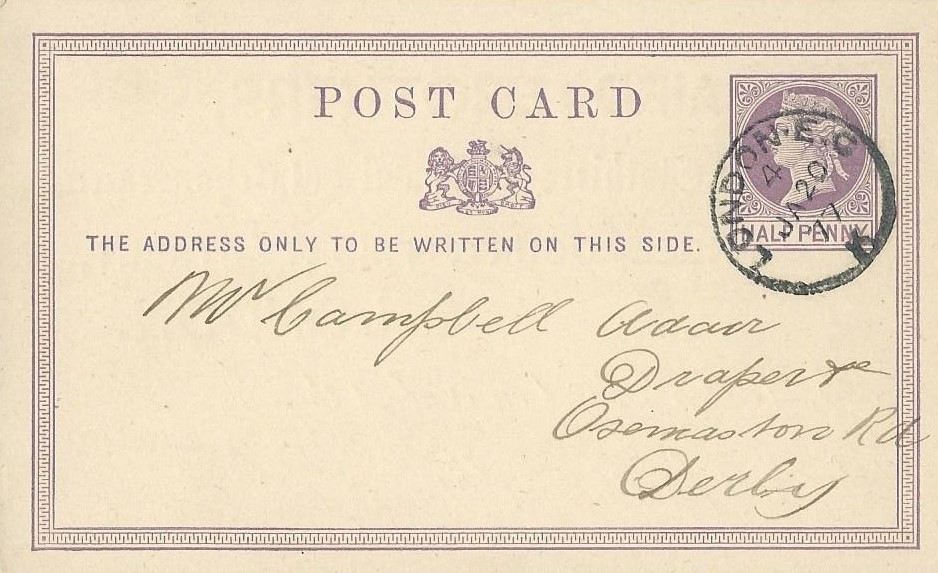
Postcard sent to Mr Campbell Adair, Drapers?, Osmaston Rd, Derby. Possibly a commercial client of Baird Brothers.
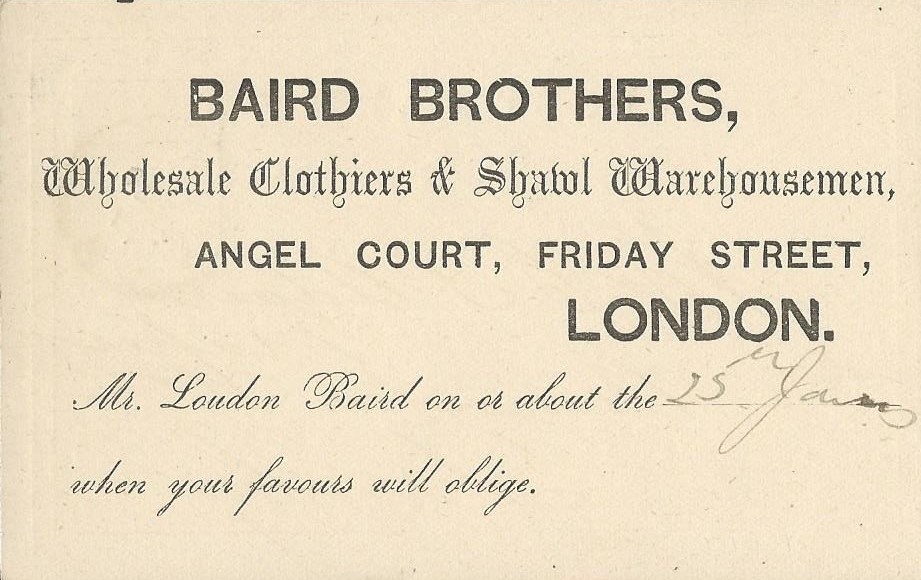
Baird Brothers Wholesale Clothiers and Shawl Warehousemen of Angel Court, Friday Street, London, using this small advertising postcard as an invitation to meet their client, “Mr Loudon Baird on about the 25 January when your favours will oblige.” Card postmarked JA 20 77 (i.e. 20th January 1877).
In 1894 the Post Office gave the go-ahead to the publication of privately produced postcards, with undivided backs, and the use of an adhesive stamp. Several manufacturers started producing picture postcards, often with city views and sketches. One of the first postcard manufacturers was George Stewart of Edinburgh.
From 1894 to around 1899 these were court size (max 4.75 x 3.5 inches), and from 1899 the standard size was introduced (5.5 x 3.5 inches) which aligned us with many other countries. We can show below a very early unused Stewart postcard. This carries an image of St Giles Church, Edinburgh and will date to around 1899/1900 and is from their Castle series.
In 1902 the Post Office allowed the use of a divided back. This meant you could write the address on the right hand side of the stamp side and write a short message on the left hand side. It allowed the full front side for an image or photograph. This change heralded the start of a golden era for postcards. Britain was the first country to introduce the ‘divided back’ and the rest of the world followed.
In 1903 Kodak introduced a camera, affordable to most people, that was designed to take postcard size negatives. The 3A Folding Pocket Kodak (3A FPK) camera was a spectacular success, and 7 model types were made and sold from 1903 to 1915. These (and other camera makes that followed Kodak’s lead) gave most people the chance to take their own family photos with local scenes, and have them developed onto a standard postcard. Many of these have survived and are extremely important to Family Historians and anyone studying Social History.
The early 1900s were also a period of much change in technology, transport, aviation and fashion. These must have been exciting times as the first airships and aeroplanes took to the skies, cars started to replace horse and carriages, and long flowing elegant gowns of Edwardian fashion, gave way to simpler sharper 20s fashions. All these changes are captured in early postcards. Social History and Family History are intrinsically bound together as you study the images, decipher the message (some of the handwriting is hard to read) and look up names, addresses and dates. In many cases you’ll be able to cross reference the information to family history records (in particular the 1901 census, 1911 census and 1921 census.