
National Registration – The response to a ‘great national crisis’
The National Registers of 1915 and 1939
Britain has twice turned to the use of a national register in a time of conflict and great national crisis. The national register of 1915 was used to help quantify manpower for use in the First World War efforts. The information contained within the 1915 register helped various government bodies and departments distinguish between those that could be called up for national service, and those that would be better used in civil employment and other non-military occupations. Unfortunately virtually all of the useful personal information, that would appeal to genealogists and family historians, was later destroyed leaving the 1911 census as the nearest census to the start of the first world war.
The national register of 1939 was also used to control the armed forces call up, but in addition the 1939 register was also used for the introduction of national identity cards and ration cards across the whole population. This section of the Family History website is dedicated to national registration act records both for 1915 and 1939, to the parliamentary debate and procedures that brought these acts into existence, and the effect upon the UK population including registration procedures and the distribution of the 1915 registration cards, and identity cards for the 1939 register.
National Registration Act 1915
On 29th June 1915, when the First World War had been underway for some 11 months, Mr Walter Long, The President of the Local Government Board introduced the National Registration Bill into Parliament. It was, it appears, quite a stirring speech and we’ve included some excerpts below:
“I beg to move, “That leave be granted to introduce a Bill for the compilation of a National Register.”
“The justification for the Bill which I have now the honour to ask the House to allow me to introduce is to be found in language used by the Prime Minister in a speech delivered in this House on a very recent occasion, which I am confident profoundly moved all those who heard it and which, I believe, most faithfully represented, not only the views which are held in the country, but also the overwhelming desires of the vast majority of our people. The Prime Minister said:- We have for the moment one plain, paramount duty to perform—to bring to the service of the State the willing and organised help of every class in the Kingdom. May I, as an illustration of that, quote a remark attributed to one of our most distinguished old soldiers and citizens, Sir Evelyn Wood. It was reported of him that a short time ago he had a conversation with some Member of the Government, and he said:- You want my services. They are at your disposal, but I ask you to tell me what I am to do. Sweep a crossing? Yes, give me the broom. That I believe to be the feeling of everybody in this country, and the object of this Bill is not to coerce labour, but to secure complete and general and satisfactory organisation. Before we decide what we are going to do with our resources in a time of great national crisis, it seems to me to be obvious that we must ascertain as carefully as we can what those resources are. I would venture to illustrate this by a very common reference to ordinary business relations. Surely the ordinary business man not only takes stock of all that he has and what he can do with it, but he does something more—he keeps a careful record of his financial position. He has, in other words, his bank book, which tells him what he has got, what securities he has available, which of them are already mortgaged for other purposes, and which he can usefully employ for the said purpose of the moment. It is in order that the State may do this that I ask the House to enable a national register to be formed…”
To view a pdf copy of the National Registration Act on the legislation.gov.uk website visit National Registration Act 1915
The 1915 register applied only to males and females between the age of fifteen and sixty-five and did not include members of the royal navy or armed forces. 29 million forms were distributed in England, Scotland and Wales and individuals – both male and female – aged between 15 and 65 were responsible for completing their own form. This was unlike the national decennial census where the heads of the household were responsible for completing the forms. National registration day was 15th August 1915 and from that day the forms were collected and collated at a local level. The statistical information was then passed to the Director General. Completed forms were kept at a local level until 1921 when the authorities ordered that they be destroyed. Gloucestershire Archives have recently uncovered 2409 individual forms relating to women living in Cirencester. Fortunately these forms escaped the destruction order and have now been transcribed. They make very interesting reading and can be viewed here: Gloucestershire Archives -Cirencester – National Registration Act 1915 Records.
1915 National Registration Certificates

National Registration Card 1915 – Front Page

Middle Page showing personal details with surname removed

National Registration Card 1915 – Back Page
Once the forms had been collected, a registration certificate (also known as a national registration card) was delivered and it was the responsibility of each individual to sign and keep the certificate safe. This certificate was not a national identity card. Although similar in size and appearance to the later 1939 national registration identity card it was simply a certificate to show that a person had been entered on the register.
National Registration Act 1939
From the winter of 1938, with the war clouds gathering over Europe, there had been debate in Parliament on the need for a national register should Britain go to war with Germany. War was declared by Britain and France on Germany on 3 September 1939. On 3rd September 1939 the National Registration Bill was being presented to the House of Commons for a first reading and the second reading took place the next day on 4th September 1939. The bill was fast tracked as an emergency measure and received royal assent on 5th September 1939. The debate of the 4th September makes interesting reading. The bill was being introduced for the following reasons:
“The only statistics now available in the country are those of the 1931 census. Therefore, the object of this Bill may very reasonably be stated as that of producing up-to-date population statistics in substitution for the stale census statistics of 1931, in order that we may make the best use possible of the man-power and the woman-power available for our national activities, and also to facilitate other measures such, for instance, as the distribution of food, food supplies, and the preservation of contact between members of families which have been dispersed for example under the evacuation scheme. The national register will cover all persons in the United Kingdom at the appointed time with the exception of members of the armed forces and the Mercantile Marine. We are using the technique of the census and have divided up Great Britain into a great number of small districts, 65,000 in all. In each district there will be an enumerator, who has already been chosen and instructed. The enumerator himself or herself will distribute the returns shortly before the zero date—that is to say National Registration Day, the day on which each person must register. The enumerator will personally collect the returns immediately after the zero date.
Clause 3 makes provision for the creation of the enumeration districts and the larger areas comprising a group of enumeration districts. The enumerators will be under the supervision of an officer in charge of the area. The enumerator will first go round with the returns to every household in his particular district, and will distribute the form and give notice that he will come back the next week to collect it and to check it with the householder to see that it is properly filled up. When the enumerator pays his second visit for the collection of the form he will leave an identity card, which will be personal to each individual. An identity card will have to be left for every person. Nothing could be more useful and more essential than such a card. It will afford means by which if families become separated they can easily be checked off. For instance, a lost child whose parents may have moved since the child was evacuated could very easily be traced and parents and child could be brought into touch with each other.”
It appears that there was a lively debate, some muted opposition, and even a hint of humour, despite the grave situation facing the nation. It’s worth noting some points made by Sir Herbert Williams:
“…On a great many occasions I have tried to find out from him and from others what would be the purpose of such a register, but I have never yet discovered. This is not an occasion for resisting Measures proposed by the Government; we can only sign on the dotted line, for debate is a waste of time…
…What this Bill is for, I have not the faintest idea. The Minister of Health says that he wants it for rationing purposes. Why? There is no difficulty in finding out approximately what is the population in any district. If the Minister got the local authority on the telephone, they would tell him immediately. How long will it take for it to be done by this means? How long will it be before the register is completed? It may be quite a good idea to give identity cards to people, so that if one wants to know who a person is, that person will be able to produce a paper to prove his identity. But how long will it take to sort out 48,000,000 cards? When they are sorted out, what is to be done with them? Nobody knows….
…He will have thousands of girls, presumably, sitting in front of tabulating machines and punching innumerable holes in small cards so that it will be possible to find out how many ladies with size-eight feet, have pink eyes.”.
To which Sir Francis Fremantle replied “Why pink eyes”
.
Other points discussed in this debate were the 1941 census and Sir Francis Fremantle sought assurances that it would still be taken:
“Can the right hon. Gentleman assure me that this register will not interfere with the ordinary Census of 1941?”
[To which Mr Colville replied]
“The year 1941 seems a long time ahead these days, but the 1941 Census, if it is possible to take it, will be taken on the same lines as previously.”
The 1941 census was never taken, as Britain was still heavy at war and in a dire situation with worries of an impending invasion. So the 1939 register acts as an important substitute for the 1941 census and holds most of the information of a normal national census.
In the second reading of the bill there were also discussions as to the possibility of introducing identity discs similar to the identity discs used by soldiers in the First World War. A number of members felt that these type of discs would not be lost or damaged in the same way as an identity card. Sir F Fremantle stated:
“…I raised a question some six months ago of the introduction of identity discs. Our minds go back—those of us who served in the last War—to the identity discs of those days, which were small bits of metal that were hung round the neck, about the size of a sixpence or a shilling. They are permanent, and they are easily hung and kept under the clothing, without being noticed, but what will happen to these identity cards? If they are hung round a child’s neck, they will not remain there for very long, and still less will they remain decipherable. Therefore, I hope we may get some possibility of identity discs being issued instead of identity cards….”

National Register – 1939. Instructions to Householders
These members didn’t get their way and identity cards were issued by the enumerators on National Registration Day 29th September 1939. A little instruction form N.R 50 (see copy of an original form) and a schedule (to be completed by every household) was delivered to every household in advance with advice such as ‘When the Enumerator collects the schedule, he must write and deliver an Identity Card for every person included in the return. Help him to write them properly for you by letting him write at a table’. It was a requirement of the act that these id cards be produced on demand or at a police station within 48 hours.
National Registration Identity Cards
There were a number of types of national registration card issued for the 1939 register. The cards were issued for identification purposes, to assist with the call up, and for the issue of ration cards including food ration and clothing ration books. We have produced below a photograph of an original standard registration identity card and, even though this one was issued in May 1940, this is the same format as the first ones issued in September 1939. These cards included an enumeration district code i.e. CLA in the card below was a Croydon enumeration district. FindMyPast have published some images of original 1939 register forms including enumerator instructions and household instructions.
There were also id cards for under sixteens and cards for certain professions such as the police. We will be using this section to publish images of original registration cards. So please revisit again soon as we have other types of id cards, newspaper cuttings, and other interesting documents relating to the National Registration Act of 1939 and 1915 that we will continue adding to this section of our Family History website. We will be redacting some personal information such as surnames and first lines of addresses.
Adult National Registration card for over 16 year olds

National Registration Identity Card 1940 – front page
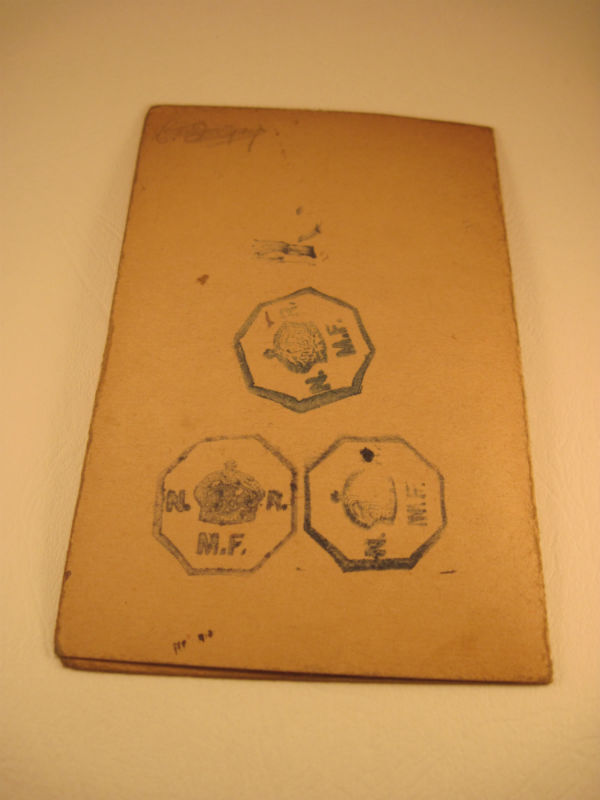
National Registration Identity Card – back page
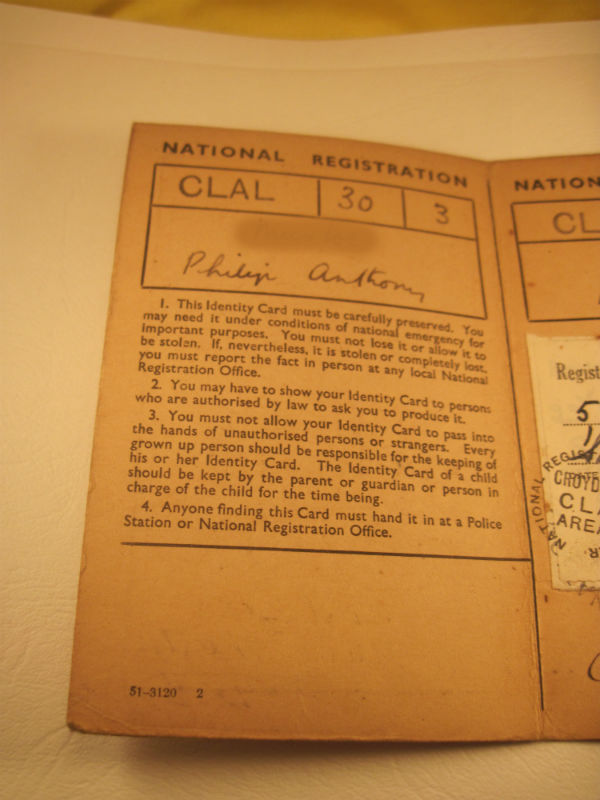
National Registration Identity Card – close up of inside left page

National Registration Identity Card – close up of inside right page

National Registration Identity Card – inside page with surname removed.
Under 16 year old National Registration Card

National Registration Identity Card 1945 – Under 16 Years – Front page.

National Registration Identity Card 1945 – Under 16 Years – back page.

National Registration Identity Card 1945 – Under 16 Years – inside page with surname removed.

National Registration Identity Card 1945 – Under 16 Years – close up of inside page.
Local Newspaper cutting – National Service (Armed Forces) Act 1939
This is a local (Cornwall) newspaper cutting from Friday 20th October 1939 detailing how National Identity Cards were to be used in the call up process. This type of article would have appeared in local newspapers all over Britain.

Newspaper cutting dated October 1939 announcing the call up of men aged between 20 and 22 years of age.
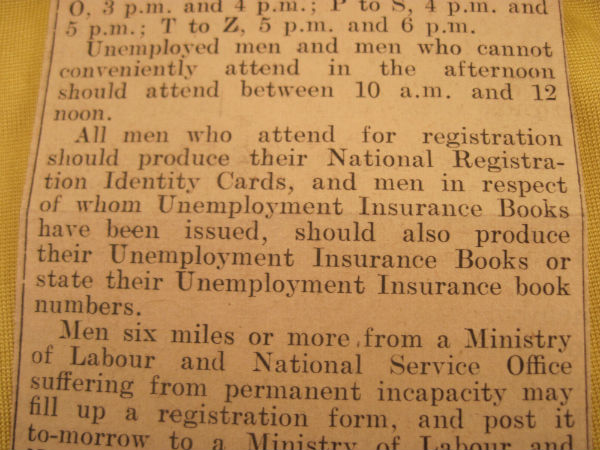
Close up of newspaper cutting showing reference to the National Registration Identity Card
Food Ration Books and Clothing Ration Books
The ration books issued during World War II always showed the National Registration Number of the holder as proof of identity. See examples of food and clothing ration books.

1942-43 Clothing ration book

1943-44 Clothing ration book
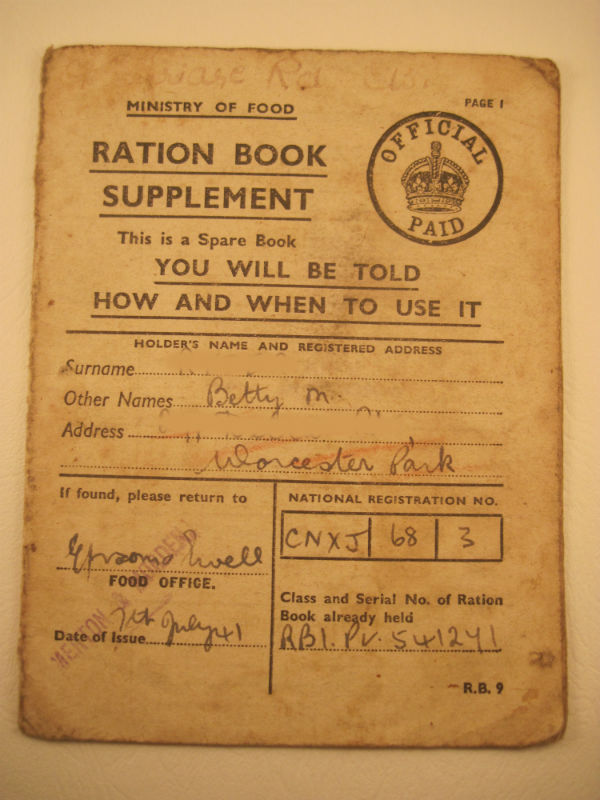
Food Ration Book issued on 7 July 1941