

By Tom Kirn, Ron Taylor, Louisa Howard – Dartmouth Electron Microscope Facility (http://remf.dartmouth.edu/imagesindex.html) [Public domain], via Wikimedia Commons
Cholera was first seen in Bengal in 1816. During the Anglo-Nepalese War (1814–16), also known as the Gurkha War. The disease then spread across India by 1820. Hundreds of thousands of Indian troops and 10,000 British troops died during the first Cholera pandemic recorded across India. Cholera reached Russia, Hungry and Germany in 1831 and claimed 130,000 lives in Egypt.
Cholera was first seen in England in 1831 as it travelled from town to town to Scotland, Northwards and London, Southwards. Bruce Haley (A Doctor at the time) claimed Cholera was “something outlandish,unknown,monstous“. This was because it was so different to the other plagues which were home-bred. This disease had been devastating whole continents.
The University of Nottingham hold an interesting transcript showing Asiatic Cholera emerging in Nottingham in 1832: it had been seen in Nottingham at the beginning of the year. It wasn’t until August when the epidemic appeared with more devastating consequences. From the 17th of August to the 24th March there were 41 new cases which were reported. Two medical Men were employed, they worked night and day for weeks. From the 17th August to November there were 930 attended cases of which 330 died giving them a survival chance of just 64.5%.
There is a fascinating record set held on the FindmyPast website in respect of the Cholera outbreak in Manchester in 1832. Manchester doctor Henry Gaulter MD took detailed notes on a number of the cases, this started on 17 May 1832 when a coach painter James Palfreyman fell ill and died three days later. The doctor also looked into lifestyles of the victims and tried to find out the cause of the outbreak. The record can be viewed here – Manchester, Lancashire Cholera Victims 1832.
The Next major outbreak in Great Britain began in 1848 lasting as long at two years. Cholera claimed 52,000 lives in England and Wales. There is a Plaque that is in remembrance of the epidemic in London from 1848-1849. It is located in Lambeth, at the junction of broad street, upper and lower fore street. Lambeth had the most cases of Cholera than in any other district.
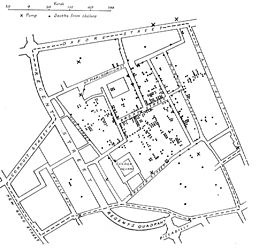
By after John Snow (UnknownTransferred from en.wikipedia to Commons.) [Public domain], via Wikimedia Commons

Filipo Pacini made the first breakthrough to understanding the disease. He went to Florence, Italy in 1854, and performed an autopsy with his microscope. He first discovered with his microscope that it was a comma-shaped bacillus and also published a paper in 1854. He developed on his findings as he described the disease as a massive loss of fluid and electrolytes due to the action of the vibrio (curved rods with single flagellum, they tolerate alkaline conditions that kill intestinal bacteria). His findings were ignored until one year after his death in 1883.
Robert Koch (1843-1910), a famous microbiologist also involved in the discovery of Tuberculosis and Anythrax. In 1883, Koch travelled to Egypt and found that the bacillus (rod-shaped bacterium) was found in those who died from cholera. This didn’t happen with other diseases so on the 7th January 1884 he announced that he had finnaly isolated the bacilli, this helped prove that they exist in abundance under damp, moist conditions.
Cholera is still very present in developing countries today, as they don’t have a safe water supply. Cholera can therefore thrive and researchers have claimed that each year there are between 21,000 and 143,000 deaths globally every year. Cholera is a disease that can cause severe watery diarrhoea. It can take up to five days for a person to show symptoms of Cholera, after consuming contaminated food or water. Many people who are infected with the bacterium, Vibrio Cholerae do not show any symptoms. However the bacterium is still present in their faeces for up to ten days after infection, once released into the environment this can infect other people.
In the 19th century, the only treatment was to be cared for at home. Physicians who would treat the sick would use treatment methods such as, opium (narcotic), which is used to treat diarrhoea. Homeopathic methods were used, these were popular with the older population, as they were being promoted in newspapers and books.
Today, if Cholera is left untreated, the disease has a mortality rate of 30-50%. Whereas if treated, the mortality rate falls to less than 1%. The basis of all treatment with Cholera is about replacing the lost fluid caused by the bacterium. It is estimated that up 80% of people can be treated with the correct use of oral rehydration salts, taken orally. Antibiotics can also be used as a treatment, the antibiotics used include Tetracycline, doxycycline or ciprofloxacin. These are used to decrease the volume and duration of diarrhoea by 50%. Drug types, antidiarrheal and antisecretory are not recommended as there hasn’t been any successful results. An oral Cholera vaccine, can prevent future infections from future encounters with the bacteria. It is most used by aid workers assisting in either refugee or disaster relief camps.